Introduction
Responsible GenAI adoption is becoming critical as AI coding assistants and AI copilots rapidly gain traction among engineering teams. While these tools boost productivity and accelerate feature delivery, they also introduce ethical, legal, and operational risks. This article presents a sprint-ready checklist and practical framework to help developers and engineering leaders use GenAI responsibly, securely, and accountably. It’s designed for seamless integration into existing development workflows, supported by AWS-native services and aligned with real-world enterprise needs.
GenAI in Production: A Framework for Responsible Development
Generative AI has become standard practice in software development. Engineering teams now routinely use tools like GitHub Copilot, Amazon Q Developer, and ChatGPT for code generation, refactoring, and documentation. Product teams are simultaneously embedding AI-powered features like conversational interfaces, content summarization, and intelligent recommendations directly into customer-facing applications.
This transformation is fast, but not risk-free.
This widespread adoption accelerates development but introduces serious technical challenges. Prompt injection vulnerabilities, flawed AI-generated code, data exposure risks, and misuse of generated content create engineering problems that require systematic solutions, not just policy guidelines.
Success demands robust design principles, strict implementation standards, and clear team accountability. At Compileinfy, we’ve created a practical, checklist-driven methodology to help engineering organizations integrate GenAI responsibly across their development lifecycle, based on extensive client experience within the AWS ecosystem.
The Hidden Risks of GenAI in Software Development Workflows
Most engineering teams adopt GenAI incrementally, starting with productivity tools and evolving into product integrations. In both cases, risks emerge quickly:
- IP Leakage: Developers unknowingly expose proprietary code or architecture through prompts to third-party AI tools.
- Hallucinated Logic: GenAI tools may suggest code that is syntactically correct but logically flawed or insecure.
- Injection Attacks: User inputs passed directly to LLMs without sanitization can manipulate outputs or expose internal prompts.
- Lack of Traceability: Teams using GenAI-generated content may lack proper logs, versioning, or metadata to support audits or root cause analysis.
- Over-Reliance: Developers may skip peer review or critical analysis, assuming GenAI outputs are always valid.
None of these problems are solved by policy alone. Responsibility must be embedded in how teams design, build, and ship software.
Responsible GenAI Starts with a Framework, Not Just Guardrails
While principles like “do no harm” and “ensure fairness” provide valuable guidance, they fall short of addressing the practical needs of development teams operating under tight deadlines. Engineering organizations require concrete implementation steps, version-controlled procedures, and measurable validation criteria. In essence, they need an executable framework.
Our methodology converts abstract ethical objectives into specific development tasks that can be:
- Incorporated into sprint planning sessions
- Monitored through project management platforms like Jira or GitHub
- Embedded within continuous integration and deployment pipelines
- Validated using AWS-native monitoring and compliance tools
This systematic approach transforms GenAI responsibility from a conceptual goal into an engineering discipline establishing accountability during the development phase rather than scrambling to address issues after deployment.
The Compileinfy Framework for Responsible GenAI Usage
We divide the framework into three categories, each with concrete checklist items developers and engineering leaders can adopt immediately.
Using GenAI for Internal Developer Productivity
Tools: GitHub Copilot, Amazon Q Developer, ChatGPT, Claude, etc.
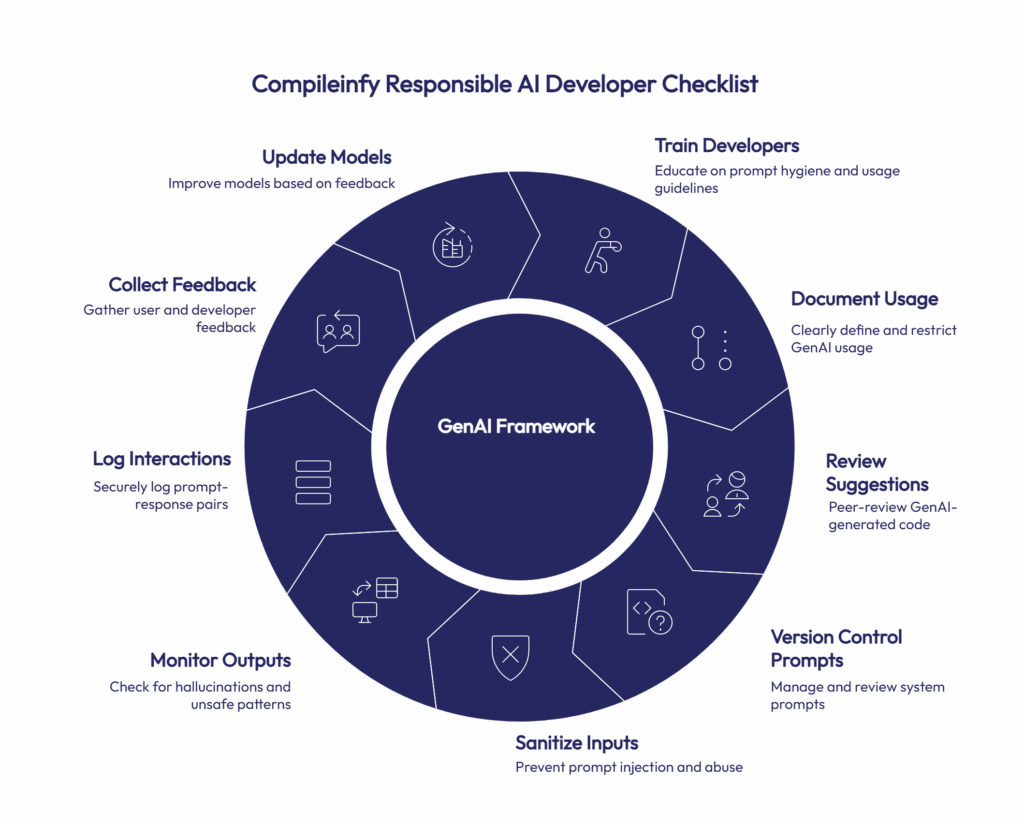
- Are developers trained on prompt hygiene, including what not to share (credentials, IP)?
- Is usage of GenAI tools for production code clearly documented or restricted?
- Is sensitive business logic excluded from AI assistant interactions?
- Are GenAI-generated suggestions peer-reviewed before being merged?
- Is annotation or metadata added to track code blocks generated with GenAI?
Integrating GenAI Features into Software Products
Use Cases: Chatbots, summarization tools, search, classification, code generation
- Have system prompts and templates been version-controlled and reviewed for risk?
- Are user inputs sanitized to prevent prompt injection or abusive content?
- Is the output monitored for hallucinations, toxicity, and unsafe patterns?
- Are fallback mechanisms in place if the LLM fails, times out, or produces unusable results?
- Is there a human-in-the-loop process or escalation route for sensitive responses?
Monitoring, Logging, and Post-Deployment Controls
- Are prompt-response pairs logged securely with access controls?
- Is user or developer feedback collected and tied to usage metrics?
- Are AWS services like CloudWatch, CloudTrail, and IAM policies in place to audit GenAI tool usage?
- Is there a process for updating models, prompts, or guardrails based on failure cases?
Embedding Responsible GenAI into Engineering Sprints
The framework works best when it’s integrated into agile workflows, not treated as a separate governance track.
- Use Jira epics or GitHub issues to track checklist compliance per feature
- Assign ownership: Devs write secure prompts; QA reviews outputs; MLOps handles logging and fallback systems
- Treat GenAI usage like dependencies-they need tracking, testing, and upgrade paths
- Add CI/CD steps to scan, validate, or tag GenAI-related code or prompt files
- Use AWS-native tools (e.g. Amazon Bedrock Guardrails, Lambda filters, CloudFormation policies) to enforce rules automatically
Why Compileinfy? Building Responsible GenAI Through the AWS Stack
At Compileinfy, we specialize in implementing responsible GenAI solutions—not just powerful, but trustworthy. Our deep expertise in the AWS ecosystem enables us to build scalable, ethically-governed GenAI capabilities that balance innovation with accountability and oversight.
Our responsible GenAI approach includes:
- Securing AI interactions using IAM, Lambda, and API Gateway to protect sensitive data
- Building prompt governance systems with version control, audit trails, and bias detection
- Implementing monitoring dashboards and human oversight workflows for content validation
- Leveraging Amazon Bedrock, Q Developer, and SageMaker Clarify to continuously test for algorithmic bias, model drift, and decision transparency
We partner with startups and enterprises to transform responsible AI principles into production-ready infrastructure that scales with your business while maintaining ethical standards.
FAQs - GenAI in Software Development
What are the risks of using GenAI tools like Copilot in development?
Risks include leaking proprietary code, accepting flawed or hallucinated logic, introducing insecure code, and lacking audit trails for AI-generated suggestions.
How can developers use GenAI responsibly in enterprise software?
By applying a framework that includes prompt hygiene, peer review, secure logging, and automated guardrails-integrated into agile workflows.
What guardrails should be in place when integrating GenAI features?
Input sanitization, fallback mechanisms, output moderation, logging, and human-in-the-loop review for sensitive or regulated use cases.
How can AWS tools support responsible GenAI usage?
AWS services like Bedrock Guardrails, IAM, CloudWatch, and Lambda can enforce prompt policies, secure access, and monitor model behavior in real time.
Why should engineering teams-not compliance-own GenAI ethics?
Because most risks manifest during design, coding, and deployment-not after. Ethical use of GenAI is a software quality issue, not just a governance one.
Conclusion: The Future of Dev Teams is GenAI-Augmented-and Accountable
Engineering teams are becoming increasingly reliant on GenAI tools. Whether you’re using AI assistants to accelerate development or embedding LLMs into your product, the risks are real-and rising.
Responsibility cannot be outsourced to compliance teams. Developers must treat GenAI like any other critical system dependency-one that requires testing, monitoring, and control.
With a framework like this in place, teams can innovate with confidence, safeguard user trust, and stay ahead of emerging regulations.
Compileinfy helps engineering organizations integrate GenAI safely, responsibly, and at scale-using the AWS services.